Exercise Daily — Sleeping Facing Qibla: Spiritual Alignment, Better Recovery, and the Forgotten Science of Sleep Direction
What if the way you sleep is not just a comfort habit, but a daily act of alignment for your body, your mind, and your soul?
Most people think sleep is simple. You get tired, you lie down, and hopefully you wake up feeling better. But that shallow view misses something bigger. Across Islamic teaching, Eastern traditions, and long-standing religious cultures, sleep is treated as more than rest. It is treated as a serious state of surrender, stillness, and renewal. In Islam especially, sleep is not described as something casual. The Qur’an presents sleep as a nightly taking of the soul and waking as a kind of return. That framing changes the conversation immediately. Sleep is no longer just about a mattress, a blanket, or whether your room is too hot. Sleep becomes a deeply meaningful act that touches mortality, discipline, peace, and preparation.
Understanding Sleep Direction: Qibla, North–South Alignment, and the Science Basics
Before diving deeper into spirituality and recovery, let’s simplify the fundamentals of sleep direction in a clear and practical way.
What is the Qibla?
The Qibla is the direction Muslims face during prayer, pointing toward the Kaaba in Mecca. This direction represents unity, alignment, and intentional focus in daily life—including rest and sleep.
Interestingly, some researchers and enthusiasts have suggested that the location of the Kaaba aligns closely with what is known as the Earth’s “golden ratio” point—often referenced around the 1.618 proportion when measuring distances between the poles. The golden ratio is a mathematical pattern found throughout nature, from galaxies and hurricanes to the human body. While this idea is still debated and not universally accepted in the scientific community, many see it as a symbolic reflection of balance and harmony—placing the Kaaba at a point that represents natural proportion and equilibrium on Earth.
Golden Ratio Bodybuilding: Most Effective Method For Building Muscle And losing Weight

Which Way Should You Face When Sleeping?
In traditional Islamic practice:
- Sleep on your right side
- Your face and chest should be oriented toward the Qibla
- Your head is typically positioned slightly away, while your body is angled toward the Qibla
This is not a rigid geometric rule but a natural alignment of the body in a comfortable and meaningful direction.
North–South vs Qibla Direction
The Earth has a natural magnetic flow from the North Pole to the South Pole. Some theories suggest that sleeping aligned with this direction may influence the body’s internal balance.
However, the Qibla direction is different—it is based on spiritual alignment rather than Earth’s magnetic poles. Depending on your location, the Qibla may point northeast, southeast, or another direction.
Does Electromagnetism Affect Sleep?
The human body operates using small electrical signals, including brain waves and heart rhythms. The Earth also has a magnetic field.
While some theories suggest these may interact, there is no strong scientific evidence proving that sleep direction alone significantly impacts health through electromagnetic effects.
What About Grounding (Earthing)?
Grounding refers to direct contact with the Earth, which some believe may reduce stress and inflammation.
While research is still limited, grounding—combined with a calm sleep environment—may support relaxation and recovery.
Simple Takeaway
- Qibla = spiritual direction and intentional alignment
- North–South = Earth’s magnetic reference
- Right-side sleeping = traditional and comfortable for many
- Biggest impact = calm mind, consistent routine, and quality sleep environment
That is why the subject of sleeping facing qibla deserves a serious discussion. For many Muslims, facing the qibla is already tied to prayer, identity, and obedience. But when this direction is brought into the bedroom, some people stop and ask: does it matter? Is it only symbolic? Is it cultural? Can it help with calmness, breathing, routine, or recovery? And can this practice mean something practical for modern people who train hard, live under stress, and want better sleep for better health?
The answer needs honesty. No, there is no strong clinical proof that merely rotating your bed toward the qibla will magically cure insomnia, fix your heart, or transform your athletic performance overnight. That would be an exaggeration. But that does not mean the practice is empty. Not at all. A habit can be spiritually meaningful before it is scientifically measurable. A ritual can be psychologically stabilizing before a lab can fully measure its effect. And a repeated bedtime orientation can shape calmness, regularity, and intention in ways that absolutely matter for recovery and wellness.
In Islamic thought, sleep carries a serious meaning because the Qur’an speaks about it in language that links it to death and return. The idea is not morbid. It is clarifying. Sleep is a temporary surrender. Every night you let go of activity, control, speech, movement, and outward effort. Every morning you are given another chance to rise, act, and live with purpose. That alone gives bedtime a spiritual weight many modern people have lost. Instead of scrolling, crashing, and collapsing into sleep with a racing mind, the believer can treat sleep as a conscious transition. That shift in attitude can change the whole nervous system experience of going to bed.
This is one reason the topic of direction matters. In Islam, the qibla is not just a line on a compass. It is the direction of worship, devotion, and order. It gives the body orientation and the mind focus. It reminds the person that even private acts can have meaning. When sleep is approached with that mindset, the bedroom stops being only a place of exhaustion and becomes a place of intentional recovery. In an age where many people sabotage their rest with stress, noise, devices, poor timing, and chaotic habits, that kind of order matters more than ever.
There is also a physical pattern in Islamic practice that makes this discussion stronger. The Sunnah connects bedtime with purification, remembrance, and lying on the right side. That is not the same thing as claiming there is a medical miracle in the right side itself. It means the body is being trained into a posture of order and humility before sleep. That matters because bedtime rituals are not random decorations. Repeated pre-sleep behaviors can condition the mind to wind down. Modern sleep science strongly supports the value of sleep regularity and routines. So even if a person first begins this practice for spiritual reasons, the practical effect may still include less mental noise, more consistency, and a smoother transition into rest.
There is another layer that gives sleeping facing qibla unusual emotional power: the burial connection. In Islamic burial custom, the deceased is commonly placed on the right side facing the qibla. That means the sleep posture and the burial posture echo one another. This is not meant to frighten a person. It is meant to humble them. It is meant to remind them that sleep is a small surrender before the final surrender, and that every night can be a rehearsal in trust, accountability, and peace. This symbolism is powerful because it takes something ordinary and fills it with meaning. And meaning is not a small thing. Meaning changes behavior.
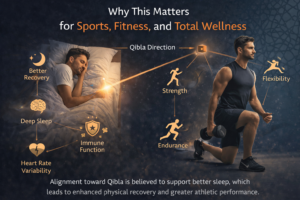
That is exactly where this topic touches health, sociology, and fitness. People sleep better when the mind is less scattered. People are calmer when life has rituals. People recover better when bedtime becomes structured rather than accidental. Athletes especially live or die by recovery quality. Training breaks the body down; sleep builds it back up. Hormonal balance, mood, reaction time, training consistency, appetite control, and next-day energy all depend heavily on sleep. So a bedtime practice that improves discipline and reduces internal chaos is not “just spiritual.” It becomes performance relevant.
Modern culture often treats spirituality and performance as if they live in different rooms. That is a mistake. A calmer mind improves recovery. A meaningful ritual can reduce stress. A stable routine can improve sleep regularity. Better sleep regularity supports better health and performance. So when someone says, “I want to sleep facing qibla because I think it may help me feel more settled and aligned,” that should not be dismissed as superstition. It may be one piece of a larger recovery system built on intention, consistency, humility, and rest.
This article is not here to sell fantasy. It is here to recover something modern life has nearly erased: the idea that how you sleep, how you prepare for sleep, and what your sleep means to you can shape your well-being. If your bed can be aligned in a way that supports your faith, reduces inner noise, reinforces discipline, and helps you approach sleep with peace instead of distraction, then repositioning it is not a strange effort. It is a worthy effort. It is simple, low-cost, and deeply connected to the larger truth that sleep is one of the most powerful recovery tools in all of wellness.
For the Muslim reader, sleeping facing the qibla can be an act of remembrance and surrender. For the athlete, it can be part of a disciplined bedtime routine. For the stressed modern adult, it can become a nightly reset. And for anyone trying to rebuild a healthier life, it can serve as a practical reminder that recovery begins before you fall asleep. It begins with direction, with stillness, and with intention.
Sleep as Temporary Death, Bed Direction, and the Deep Human Need for Ritual
One reason this subject hits so deeply is that it speaks to a truth many people feel but do not name: sleep makes human beings vulnerable. You stop defending yourself. You stop producing. You stop performing for the world. You close your eyes and disappear from conscious control for hours. In the Qur’anic view, that vulnerability is not meaningless. Sleep is described as a nightly taking of the soul and waking as a return until the appointed term. That language turns bedtime into a profound spiritual event. It reminds the person that life is temporary, that waking is a gift, and that every night offers a quiet lesson in surrender.
Once that perspective is understood, the question of posture and direction becomes more than symbolic decoration. It becomes part of how a person chooses to enter that state. In Islamic practice, sleeping on the right side and orienting oneself meaningfully is not simply about comfort. It reflects order, humility, and readiness. The connection to burial strengthens that symbolism. If the body is ultimately laid on the right side facing the qibla in death, then training oneself to sleep in a similar orientation becomes a powerful embodied reminder of purpose and mortality. This does not turn the bedroom into a grave. It turns the bedroom into a place of conscious living.
That kind of embodied reminder can have major sociological value. Modern people suffer not only from poor sleep but from fragmented meaning. They live fast, eat fast, consume fast, think fast, and often crash into bed carrying the noise of the whole day. When societies lose rituals, people lose anchors. They become more reactive, less centered, and often more anxious. A repeated bedtime orientation, especially one tied to faith, can function as a stabilizing ritual. It says: the day is over, your striving stops here, now you return to stillness, gratitude, and trust. That kind of closure matters.
Ritual has always helped human beings regulate themselves. That is why this topic is not limited to Islam alone, even though the qibla gives it a uniquely Islamic center. Across traditions, direction, posture, and death have often been linked. Christian burial has long included symbolic directional practices, and in South Asian traditions such as Ayurveda and related systems, sleep direction is often discussed in relation to harmony, energy, and rest. Feng Shui likewise treats the bedroom not as a random box but as a place whose arrangement affects mental and emotional ease. These traditions do not all say the same thing, and they do not need to. The point is deeper: human civilizations repeatedly sensed that space, direction, and rest are connected. That pattern itself is worth respecting.
Of course, modern readers should be careful. The fact that a belief is ancient does not automatically make every claim scientifically proven. But it does tell us something important: the human need to align rest with meaning is old, widespread, and durable. That matters because people do not sleep with biology alone. They sleep with beliefs, emotions, routines, habits, and environmental cues. A room can feel chaotic or peaceful. A bed can feel random or intentional. A bedtime can feel like collapse or surrender. The body notices the difference.
There is also a strong psychological advantage in choosing a sleep direction on purpose. Decisions reduce uncertainty. Ritual reduces mental friction. Intention creates closure. When you know where your body is facing and why, you are less likely to carry scattered energy into bed. That can support a calmer pre-sleep state. And a calmer pre-sleep state matters tremendously. Stress interferes with sleep. Better sleep quality supports better mental health. More regular sleep timing supports health and performance. So even before discussing spiritual reward, there is a practical human benefit in transforming bedtime from chaos into order.
This is where breathing and relaxation enter the picture. A meaningful bedtime routine often slows the whole person down. The lights go low. Speech quiets. The body settles. The mind stops negotiating with the day. The chest softens. Breathing can become slower and more deliberate. That shift is not imaginary. It is one of the main gateways into better rest. Many people today are physically in bed but mentally still running. They have not truly entered sleep mode because their nervous system has not been given a clear signal to stand down. Ritual can provide that signal.
Sleeping facing qibla can become one of those signals. It tells the mind, “I am done for today. I am placing myself in order. I am letting go.” That surrender has obvious spiritual value, but it can also support emotional regulation. People who end the day with remembrance, intentional posture, and a stable routine may find that bedtime becomes less restless. Not because the compass angle casts a magic spell, but because the whole pre-sleep experience becomes less noisy and more coherent.
This matters even more in family and community life. A home that respects rituals often feels more grounded. Children raised around meaningful routines often feel safer because the household has rhythm. Adults who maintain rituals often carry less bedtime chaos. Shared practices build identity, and identity builds stability. That is one sociological benefit of practices like sleeping facing qibla: they connect the individual to something larger than personal preference. The person is no longer just arranging furniture. They are placing themselves inside a tradition. That can reduce alienation and build continuity between belief and daily life.
There is also a humility benefit here. Repositioning a bed sounds small, but small physical acts can carry big psychological force. They tell the body that values are not just ideas in the head. Values shape space, posture, timing, and habit. That is powerful. It means spirituality is not locked in a mosque or in a prayer moment only. It enters the private architecture of life. The way you wake, the way you work, the way you eat, and the way you sleep all become connected to one moral and spiritual order.
That is why this article argues that, for many people, it is worth the effort to reposition the bed. Not because bed direction alone will solve every sleep problem, but because it is a practical and meaningful upgrade. It costs little or nothing. It increases intentionality. It can support a calmer mindset. It connects sleep to remembrance. It links the body’s nightly surrender to the larger truths of life, death, and accountability. And in a world full of expensive wellness trends, that kind of low-cost alignment is rare.
At the deepest level, sleeping facing qibla says something beautiful: recovery is not just mechanical. Rest is not only chemical. Human beings need meaning to rest well. They need peace, order, and surrender. When those things are present, sleep can become more than unconscious downtime. It becomes a form of renewal that touches body, mind, and soul together.
Why This Matters for Sports, Fitness, and Total Wellness
Now we get to the part many wellness articles miss entirely: performance. If you train, lift, run, recover, coach, or simply want to function better, sleep is not optional maintenance. It is one of the main engines of repair. Modern sports science is very clear on the big picture. Poor sleep and inconsistent sleep hurt health and performance. Better sleep quality and more stable sleep timing support recovery, mood, attention, and next-day readiness. That does not mean every person must follow one exact ritual. But it does mean bedtime habits matter, and they matter a lot.
This is why the idea of sleeping facing qibla should not be boxed into a purely religious corner. For a Muslim athlete, this practice can be both devotional and practical. It can create a structured pre-sleep sequence: reduce stimulation, prepare the body, enter bed with intention, lie down in a known posture, and settle the mind. That is already a recovery strategy. It is not the only one, but it is a legitimate one. And unlike many modern sleep hacks, it does not depend on subscriptions, gadgets, expensive supplements, or trend-based wellness marketing.
| Photo | Title | Price | Buy |
|---|---|---|---|

|
Sports Research® Sleep Complex (Melatonin-Free), 60 Veggie Capsules | $26.95 |

|

|
Pure Encapsulations Magnesium (Glycinate), 90 Capsules | $27.00 |
|

|
Primal Harvest Sleep - Daily Supplement, Gluten & Dairy Free, for Men & Women | $30.85 |
|

|
Herbs Etc. Deep Sleep Softgels, Organic Chamomile & Lemon Balm, 120 Count | $48.27 |
|

|
Apigenin 50mg, Chamomile Flavonoid, NSF Certified, 120 Capsules | $20.95 |
|

|
Tempur-Pedic TEMPUR-Cloud Pillow for Sleeping, Standard, White | $71.40 |
|

|
ECQOLRA 100% Natural Talalay Latex Pillow, Luxury Support Sleeping Bed Pillow for Side, Back, and Stomach Sleepers, Removable Breathable Cotton Cover, Standard (Medium 6.2''H) | $61.99 |
|
As an Amazon Associate, Exercise Daily earns from qualifying purchases. This post may contain affiliate links. Last updated: September 26, 2026
Think about how athletes and high performers actually succeed. Not by one huge perfect act, but by stacking repeatable small disciplines. A fixed bedtime. A lighter evening meal. Less screen exposure. A cooler room. A calmer mind. A consistent wind-down pattern. A meaningful trigger that tells the body and brain that the day is over. Sleeping facing qibla can be one of those anchors. It brings faith and routine together in a way that supports recovery rather than competing with it.
Recovery matters because training itself is only half the process. Exercise creates demand. Sleep supports adaptation. During good sleep, the body carries out repair work, the brain processes information differently, and the athlete is more likely to wake with steadier mood and stronger readiness to train. If sleep is chronically weak, everything gets harder: motivation, appetite regulation, reaction time, patience, judgment, and perceived energy. People often blame laziness when what they are really seeing is fatigue. They blame lack of discipline when the person is under-recovered. They blame the workout program when the real weak link is the bed.
That is why every serious conversation about wellness should place sleep near the top. And once sleep is taken seriously, the bedtime environment and bedtime ritual also deserve serious attention. This includes room light, noise, temperature, device use, and yes, for many believers, bed direction. If the qibla orientation helps a person approach bedtime with more seriousness and less distraction, it has value. If it makes the room feel spiritually coherent, it has value. If it encourages a person to lie down with remembrance instead of mental clutter, it has value. These are not trivial benefits. They are exactly the kind of benefits that compound over time.
There is also a powerful motivation angle here for people who struggle with consistency. Some people do not respond well to purely technical advice. “Improve sleep hygiene” sounds correct but emotionally weak. It does not move them. But “sleep like your life matters” is different. “Lie down in a way that reflects your values” is different. “Treat sleep as a trust and a temporary death before you rise again” is different. Meaning can motivate discipline where plain information fails. That is one more reason this practice deserves respect in fitness and wellness spaces.
The social side matters too. Wellness is not only individual; it is cultural. Communities shape habits. Families shape routines. If a home values intentional sleep, nightly calm, and spiritually grounded rest, the whole household may benefit. Bedtime stops feeling like a random collapse after digital overstimulation and starts becoming part of the moral rhythm of the home. That can strengthen children, reduce evening stress, and make wellness feel lived rather than preached.
None of this requires exaggerated claims. A truthful approach is stronger. We can say clearly that there is no strong medical evidence proving that simply facing qibla changes heart function or instantly deepens sleep by itself. We can also say clearly that sleep quality, sleep regularity, and bedtime calm matter tremendously for mental health, health, and athletic performance. We can further say that meaningful rituals can support these outcomes indirectly by reducing inner chaos, improving consistency, and turning bedtime into a more peaceful act. That is enough. It is honest, useful, and strong.
So should you reposition your bed? For many readers, yes. If you are Muslim and you can reasonably orient your bed toward the qibla without creating discomfort or clutter, it is a worthy effort. It is a simple way to bring your values into your recovery environment. It can strengthen intentionality. It can connect sleep to remembrance. It can create a more disciplined bedtime routine. And because recovery is one of the pillars of sports, fitness, and long-term health, that makes it relevant far beyond symbolism.
Here is the practical way to think about it. Do not treat bed direction as a magic trick. Treat it as part of a recovery system. Reposition the bed if you can. Reduce light before bedtime. Keep the room calmer. Stop carrying the phone into your final minutes if possible. Slow the evening pace. Use remembrance or quiet breathing to shift out of daytime stress. Sleep with purpose. Wake with gratitude. Repeat. That is how rituals become results.
In the end, sleeping facing qibla sits at a rare intersection. It speaks to faith, mortality, identity, posture, household culture, and recovery all at once. It reminds the believer that the body itself can remember God. It reminds the athlete that recovery is sacred, not optional. It reminds the stressed modern person that wellness does not always begin with buying something new; sometimes it begins with turning, aligning, and simplifying.
If there is one final lesson here, it is this: sleep is too important to leave meaningless. The body heals in sleep. The mind resets in sleep. The next day is built in sleep. So if aligning your bed toward the qibla helps you turn bedtime into an act of peace, order, and preparation, then move the bed. Make the effort. It is one of the simplest upgrades you can make for a life that wants more discipline, more recovery, and more wholeness.
Exercise Daily verdict: sleeping facing qibla is not a shortcut, but it is a serious and worthy practice. It links spiritual alignment with behavioral discipline, and behavioral discipline supports better recovery. In a culture that destroys sleep and then sells expensive solutions, a meaningful low-cost practice like this deserves a fresh look.
Eat daily, sleep daily, exercise daily.