
Exercise Daily _ Is It Bad to Drink Water While Standing for Digestion?
For generations, parents, grandparents, religious teachers, Ayurvedic practitioners, and even old-school coaches have repeated the same advice:
“Sit down when you drink water. It’s better for your body.”
Meanwhile, modern life looks very different. We drink water while walking, driving, scrolling, even between heavy sets at the gym. This creates a natural question for anyone who cares about their health and performance:
Is it bad to drink water while standing for digestion?
And for athletes, gym-goers, and young competitors, a second question matters just as much:
Does standing while drinking affect performance, hydration, or long-term health?
In this article, we will connect three worlds:
- modern science and sports medicine
- ancient cultural and religious traditions
- real-life habits of gym-goers and young athletes
The goal is not to scare anyone. The goal is to understand how posture, pace, and mindset around drinking water can quietly shape digestion, comfort, and performance.
How Digestion Really Works: The “Rest and Digest” System
To answer the question “is it bad to drink water while standing for digestion?” we have to talk about your nervous system first.
Your gut is controlled by the autonomic nervous system, which has two main branches:
- Sympathetic nervous system – the “fight or flight” mode
- Parasympathetic nervous system – the “rest and digest” mode
Harvard Health and other medical sources explain that when the parasympathetic system is active, your body is calmer and better able to digest food, move it along the intestines, and absorb nutrients properly. This is why it is called “rest and digest.”
Research on the brain–gut connection shows that this balance between “fight or flight” and “rest and digest” affects:
- how fast food moves through your system
- how well nutrients are absorbed
- how much digestive juice and enzymes are released
- how inflamed or calm the gut lining is
Put simply: your digestion works best when your body is relaxed, breathing is steady, and you are not rushing.
What Does This Have To Do With Sitting or Standing?
Sitting does not magically “heal” digestion. Standing does not automatically “damage” it.
But posture changes how you behave:
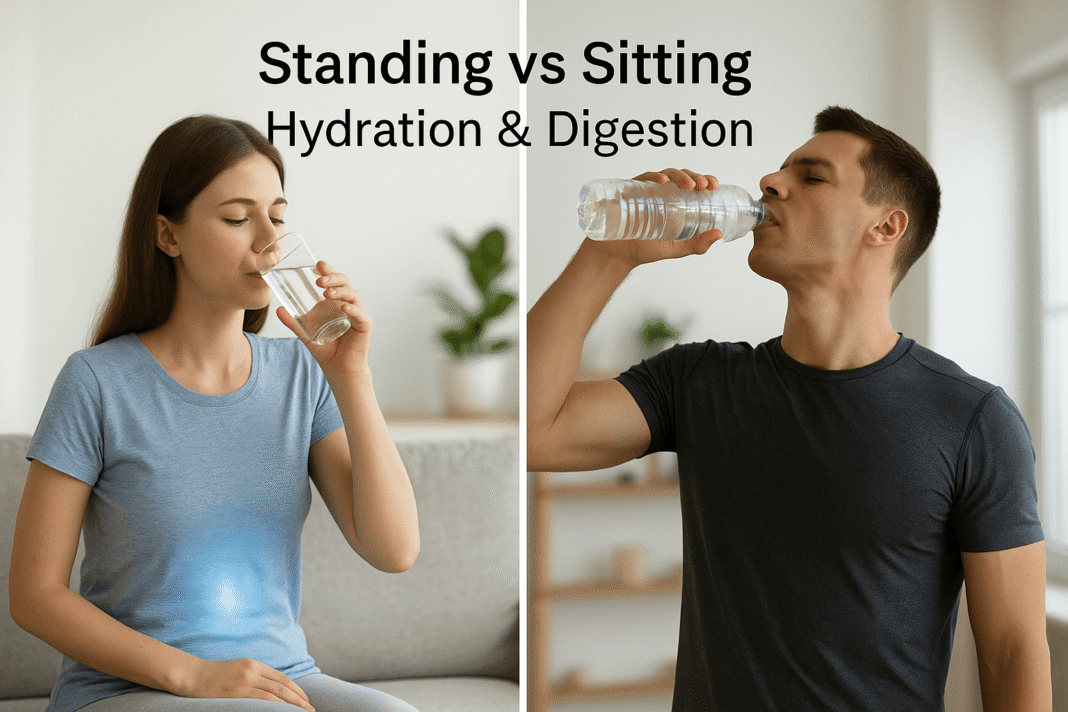
- When you are sitting, you tend to slow down, breathe more calmly, and sip.
- When you are standing or walking, you are much more likely to gulp quickly and be half-distracted or stressed.
Harvard and Mayo Clinic both emphasize that eating and drinking slowly, in a relaxed context, helps you swallow less air and may reduce problems like gas, bloating, and discomfort. Eating or drinking “on the run” increases swallowed air and irritation.
So scientifically, the problem is less “standing” itself and more the fast, distracted behavior that usually comes with it.
Standing, Digestion, and Bloating: What the Evidence Suggests
There is no strong Western medical study proving that standing while drinking water directly causes kidney damage, joint damage, or permanent digestive injury.
However, we can connect a few facts:
- Fast drinking while upright can increase swallowed air, making bloating, belching, and gas more common.
- Stress and rush push the body toward sympathetic “fight or flight,” which is linked to slower or more chaotic digestion and discomfort. :contentReference[oaicite:4]{index=4}
- People with reflux or GERD often find that quick intake of liquids, especially near meals, can worsen symptoms.
So if someone asks, “Is it bad to drink water while standing for digestion?” a realistic answer is:
- Standing is not toxic by itself.
- But drinking quickly, while distracted or stressed, is more likely to cause digestive discomfort.
- Sitting makes it easier to drink slowly and stay in “rest and digest” mode.
What About Athletes, Gym-Goers, and Young Competitors?
| Photo | Title | Price | Buy |
|---|---|---|---|

|
AVA DESIGNZ Copper Water Bottle for Drinking 950ml Hammered Finish, 32 Oz Large Hammered Ayurvedic Copper Bottle with Blue Canvas Bag & Cleaning Brush, Leak-Proof Cooper Water Bottle |

|
|
|
PrakRtyA: Clay Water Bottle for Drinking – Handmade Terracotta Earthen Bottle | Natural Mitti Water Bottle | Eco-Friendly, BPA-Free, Chemical-Free, Reusable Water Container | $39.99 |
|

|
Clay Water Filter by Ceramica, 6 Liter Gravity System, Ceramic Cartridge Included, No Power Required, Brown |
|
|

|
Copper Water Bottle - 34oz - Handcrafted Ayurvedic 100% Pure Copper Water Bottle for Drinking |Men & Women| Leak-Proof Lid BPA Free Non-Insulated & Eco Friendly with Premium Quality for Sport & Travel | $29.99 |
|

|
Bambaw Stainless Steel Water Bottles 32 oz, Non-insulated Single Wall Metal Water Bottle Stainless Steel, Reusable & Eco Friendly, Dishwasher Safe – Silver | $17.95 |
|

|
BOOST Smart Water Bottle with Reminder & Tracker, Double Wall Vacuum Insulated Bottles Stainless Steel, 32oz BPA-Free Wide Mouth for School, Gym, Office, Ideal for Mother's Day | $46.74 |
|
As an Amazon Associate, Exercise Daily earns from qualifying purchases. This post may contain affiliate links. Last updated: April 2, 2026
Now let’s connect this to fitness, exercise, and the real world of workouts and sports.
Fast Hydration vs. Smart Hydration
The American College of Sports Medicine (ACSM) and other sports science groups are clear about one thing: adequate fluid replacement is critical for health, safety, and performance during exercise. :contentReference[oaicite:6]{index=6}
Key ideas from hydration research include:
- Start activity already hydrated.
- Replace losses gradually, not in one giant gulp.
- Balance fluids and electrolytes, especially in heat.
For young athletes, specific guidelines emphasize regular, scheduled drinking before, during, and after activity to reduce the risk of dehydration and heat illness.
Standing and Drinking in the Gym
Now imagine a typical gym scene:
- Someone finishes a heavy set of squats.
- They walk straight to the fountain or bottle.
- They chug water fast while standing, breathing hard, and maybe talking.
What can this cause?
- Stomach sloshing during the next set
- Cramps if the stomach gets too full too quickly
- Bloating from swallowed air
- In some, acid reflux when the stomach is abruptly distended
None of this is “dangerous” in most cases, but it is uncomfortable and can absolutely affect performance, timing, and how confident a lifter or young athlete feels mid-session.
Why Sitting Helps Active People
Sitting between sets or during breaks naturally encourages:
- slower, smaller sips instead of big gulps
- calmer breathing and heart rate
- a stronger shift back toward the parasympathetic “rest and digest” side, which supports digestion and recovery.
So for gym-goers and young athletes, the real risk of standing while drinking is not that it “destroys kidneys,” but that it encourages rushed, shallow, poorly timed hydration that can:
- hurt comfort
- reduce performance
- create a bad relationship with drinking during training
Cultural and Religious Teachings: Why Our Elders Insisted We Sit
Now we step into the cultural and spiritual side of the debate.
Islamic Tradition
In many Muslim households, elders teach that drinking while sitting is better. Several hadiths report that the Prophet Muhammad (peace be upon him) encouraged sitting while drinking water in daily life, with some exceptions (such as Zamzam water).
While these narrations are often explained in moral and spiritual terms, they also indirectly support habits that calm the body, slow the mind, and prevent choking or over-gulping.
Ayurveda (Traditional Indian Medicine)
Ayurveda teaches that water should be drunk:
- in a seated posture
- in small sips, not large gulps
- at a comfortable, moderate temperature
Standing while drinking is said to “disturb the fluids” and upset Agni, the digestive fire. While this language is symbolic and not the same as modern physiology, the core message matches what digestion science is now confirming: rushed intake in an activated state is not ideal for the gut.
Persian / Iranian Family Wisdom
In many Persian households, children grow up hearing something like:
“Don’t drink water like that, you’re shocking your body. Sit down first.”
This is not based on PubMed trials, but on long observation: kids who run in overheated and gulp ice-cold water standing up often complain of stomach pain or discomfort. Over time, that pattern became a cultural rule.
Japanese and East Asian Rituals
In Japanese tea ceremony and other East Asian traditions, drinking is a ritual. People sit, pause, breathe, and treat the act of drinking as something almost sacred.
Again, this posture naturally activates “rest and digest,” slows down intake, and protects the stomach from the “fast life” our nervous system was never designed for.
So… Is It Bad To Drink Water While Standing for Digestion?
Let’s answer clearly and honestly.
- No: There is no solid Western scientific proof that simply standing while drinking water directly harms kidneys, joints, or permanently damages the digestive tract.
- Yes, kind of: Standing is often linked with rushed, stressed, distracted drinking, which absolutely can increase bloating, discomfort, and reflux in some people and may not support optimal digestion.
For everyday people, gym-goers, and young athletes, a more useful way to phrase it might be:
“It’s not that standing is toxic. It’s that sitting makes it much easier to drink in a calm, slow, digestion-friendly way.”
In other words:
- Hydration and total water intake are still the most important factors.
- But posture shapes behavior, and behavior shapes digestion and performance.
Practical Tips for Gym-Goers and Young Athletes
- Sit whenever you can between sets or drills. Use those 30–60 seconds to breathe and take a few small sips.
- Avoid chugging huge amounts at once. Steady, regular intake is better for both performance and comfort.
- Plan hydration, don’t improvise it. Follow established guidelines for pre-hydration and during-exercise fluids from organizations like ACSM. :contentReference[oaicite:9]{index=9}
- Teach young athletes rhythm and respect around water. Use water breaks as a moment of calm, not chaos.
For deeper lifestyle changes, also explore content in our nutrition, wellness, and personal care categories to build daily habits that support your training.
A Controversial but Honest Conclusion
So, is it bad to drink water while standing for digestion?
Here is the Exercise Daily answer:
- Scientifically: Standing is not a proven enemy. The real villain is rushed, stressed, distracted drinking.
- Culturally and spiritually: Sitting to drink is a powerful, time-tested practice that aligns with calmness, mindfulness, respect, and often better comfort.
- For athletes and gym-goers: Sitting, slowing down, and sipping makes more sense than chugging while pacing around the gym between sets.
When science, tradition, and performance all quietly point in the same direction, it may be worth listening.
Practical takeaway: Stay hydrated first. But whenever you have the choice, sit, breathe, and drink like your digestion actually matters.
References
- Mallard SA, Crofts G, Taylor NAS.
Influence of Acute Water Ingestion and Prolonged Standing on Raw Bioimpedance and Subsequent Body Fluid and Composition Estimates.
Journal of Electrical Bioimpedance. 2022.
Available from:
https://pubmed.ncbi.nlm.nih.gov/35646197/ - Parkman HP, Camilleri M, Farrugia G.
Effects of Posture on Gastric Emptying: Sitting vs Right-Lateral Recumbent Positions.
Journal of Neurogastroenterology and Motility. 2013.
Full text:
https://pmc.ncbi.nlm.nih.gov/articles/PMC3554820/ - Mayo Clinic Staff.
Belching, Gas, and Bloating: Tips for Reducing Them.
Mayo Clinic.
Accessed 2024.
Available from:
https://www.mayoclinic.org/diseases-conditions/gas-and-gas-pains/in-depth/gas-and-gas-pains/art-20044739
Disclaimer: These are for informational purposes only. Consult your doctor and do your own research before use.
Eat daily, sleep daily, exercise daily.