Exercise Daily _ How To Improve Foot Speed For Soccer
Most players and coaches wrongly believe that foot speed is purely a genetic gift, something you either have or you don’t. This myth perpetuates a culture of inaction, where aspiring soccer players resign themselves to their perceived limitations instead of actively working to enhance their speed. The truth is, foot speed can be developed through targeted training, specific drills, and a keen understanding of biomechanics. In this article, we will explore effective strategies to boost your foot speed on the soccer field, challenging the old myths and providing you with actionable advice.
Who This Is For
- Beginner soccer players looking to enhance their basic skills.
- Intermediate athletes aiming to refine their speed and agility.
- Coaches seeking effective drills for their teams.
- Parents of young athletes who want to support their children’s development.
- Busy adults trying to maximize their training efficiency.
What Most People Get Wrong



As an Amazon Associate, Exercise Daily earns from qualifying purchases. This post may contain affiliate links. Last updated: September 19, 2026
Many athletes focus solely on sprinting drills, neglecting the importance of agility and footwork. While straight-line speed is vital, soccer is a dynamic sport that requires quick changes in direction, acceleration, and deceleration. A common mistake is to assume that running fast in a straight line translates directly to effective foot speed in soccer. In reality, foot speed encompasses much more than just running speed; it includes reaction time, balance, coordination, and the ability to move efficiently in multiple directions.
Another misconception is that strength training is counterproductive for speed. This belief leads many players to avoid weight training altogether, missing out on the benefits that strength can provide. Research shows that a well-structured strength training program can enhance muscle power and, in turn, improve speed on the field (Haff et al., 2008). The key lies in the specificity of the training—focusing on exercises that mimic the demands of soccer.
Why This Actually Works
Improving foot speed for soccer involves a multifaceted approach that integrates strength, agility, and skill training. Here are several evidence-based strategies to enhance your foot speed:
1. Plyometric Training
Plyometrics, or jump training, can significantly enhance your explosive power and foot speed. Exercises such as box jumps, depth jumps, and lateral bounds improve the fast-twitch muscle fibers essential for quick bursts of speed. A study published in the Journal of Sports Science and Medicine found that plyometric training enhanced both speed and agility in young athletes (Markovic & Mikulic, 2010).
To effectively incorporate plyometric training into your routine, aim for 2-3 sessions per week. Begin with basic movements before progressing to more complex exercises. For example, start with basic box jumps, focusing on landing softly and absorbing the impact through your knees. As you become more comfortable, incorporate lateral bounds to enhance your side-to-side movement, which is crucial in soccer.
2. Agility Drills
Agility drills are crucial for improving your foot speed in soccer. Incorporate ladder drills, cone drills, and shuttle runs into your training regimen. These drills develop quick foot movements and enhance your ability to change direction rapidly. A systematic review in the Journal of Strength and Conditioning Research highlighted that agility training enhances athletic performance by improving speed and reaction times (Buchheit & Laursen, 2013).
For practical application, set up a series of cones in various patterns (zig-zag, T-shape, etc.) and practice sprinting to each cone, focusing on quick foot placement and maintaining control. Additionally, ladder drills can be done with various foot patterns, such as two feet in each square or single-foot hops, to develop coordination and speed. Aim to perform agility drills 2-3 times a week, gradually increasing the complexity and speed of the drills as you improve.
3. Strength Training
Incorporating strength training into your routine can bolster your foot speed. Focus on compound movements such as squats, deadlifts, and lunges, which engage multiple muscle groups and promote overall strength. Studies indicate that strength training enhances sprint performance, particularly when combined with sprint-specific drills (Balsalobre-Fernandez et al., 2016).
When designing your strength training program, aim for 2-4 sessions per week, incorporating both lower body and core exercises. For example, you could begin with squats to build leg strength, followed by deadlifts to engage your posterior chain. Additionally, include exercises like step-ups and Bulgarian split squats to target the muscles used in soccer movements. Ensure you progressively increase the weights as your strength improves, but always prioritize proper form to prevent injuries.
4. Technique Work
Improving your running technique can have a profound impact on your foot speed. Work on maintaining proper posture, optimizing your stride length, and ensuring your foot strikes the ground correctly. Video analysis can be a useful tool to identify areas for improvement. A study in the Journal of Sports Biomechanics found that proper running mechanics significantly contribute to improved sprinting performance (Schoenfeld et al., 2014).
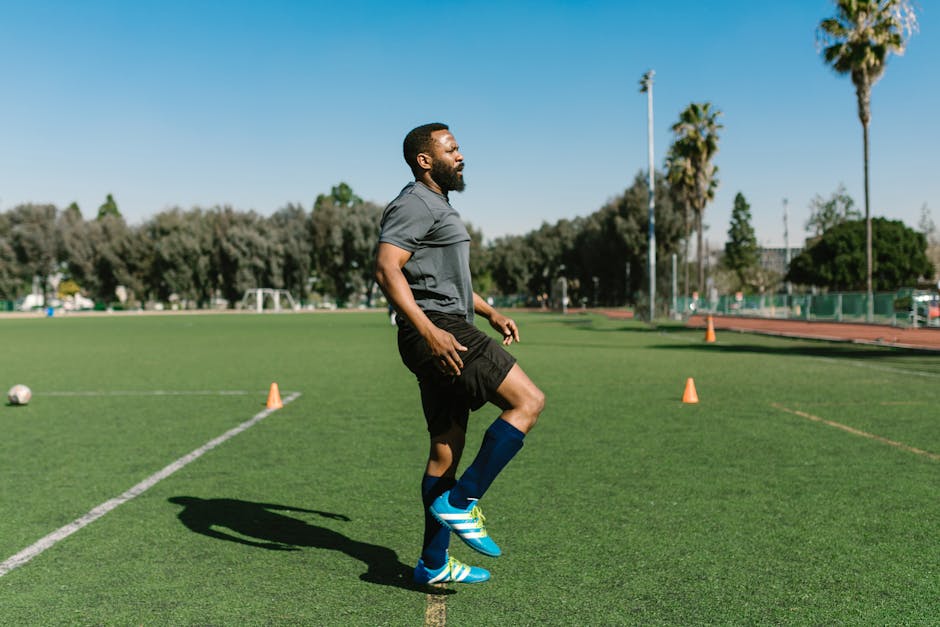
To work on your technique, consider filming your runs from various angles and analyzing the footage for issues such as overstriding or poor arm movement. Additionally, working with a coach or experienced teammate can provide valuable feedback. Drills focusing on form, such as high knees, butt kicks, and straight-leg bounds, can also enhance your running efficiency. Regularly practicing these drills will help reinforce good habits, making them second nature during games.
5. Interval Training
High-Intensity Interval Training (HIIT) can also enhance foot speed by improving your anaerobic capacity and recovery time. Incorporate short bursts of high-intensity sprints followed by rest or low-intensity activity. This training method has been shown to improve both speed and cardiovascular fitness (Gibala et al., 2012).
For effective HIIT sessions, consider structuring your workouts with a ratio of 1:2 or 1:3 (work to rest). For example, sprint for 20 seconds at maximum effort, followed by 40-60 seconds of walking or light jogging. Repeat this cycle for 15-20 minutes, gradually increasing the intensity or duration of the sprints as your fitness improves. This method not only boosts your speed but also enhances your endurance, allowing you to maintain a high level of performance throughout the game.
Practical Examples
Implementing these strategies into your training can be straightforward. For instance, consider a weekly training plan that includes:
- Day 1: Plyometric training focusing on box jumps and lateral bounds.
- Day 2: Agility drills with ladder and cone exercises.
- Day 3: Strength training targeting lower body and core, incorporating squats and deadlifts.
- Day 4: Technique work with video analysis and drills focusing on running form.
- Day 5: HIIT sessions with sprints and active recovery.
Over time, you should notice improvements in your foot speed, which will translate to better performance on the soccer field. Additionally, consider tracking your progress by timing your sprints or measuring your agility through specific drills. This will not only motivate you but also provide tangible evidence of your improvement.
Frequently Asked Questions
1. How long does it take to see improvements in foot speed?
Improvements can typically be seen within 4-6 weeks of consistent training. However, this varies based on your current fitness level and the intensity of your training regimen. Staying committed to your training plan and regularly challenging yourself will yield the best results.
2. Can I improve my foot speed without a gym?
Yes, many effective drills can be performed without gym equipment, such as agility drills, plyometrics, and sprinting exercises in your backyard or at a local park. Bodyweight exercises like squats, lunges, and plyometric jumps can be done anywhere, making it easy to incorporate strength training into your routine.
3. Is it safe to do plyometric training regularly?
Plyometric training is safe when performed with proper technique and progression. It’s essential to start at a level appropriate for your fitness and gradually increase intensity to avoid injury. Ensure you include a proper warm-up and cool-down in every session to maintain flexibility and reduce the risk of injury.
Conclusion
Improving foot speed for soccer is not an unattainable goal reserved for the naturally gifted. By debunking myths and implementing targeted strategies—such as plyometric training, agility drills, strength training, and technique work—you can enhance your foot speed and overall performance on the field. Remember, consistency is key, and with dedication, you can transform your game.
For more insights on exercise and fitness, check out our articles on exercise and fitness. Eat daily, sleep daily, exercise daily.
- Haff, G. G., et al. (2008). “The Effect of Strength Training on Speed and Agility in Young Athletes.”
- Markovic, G., & Mikulic, P. (2010). “Does plyometric training improve vertical jump height? A meta-analytical review.”
- Buchheit, M., & Laursen, P. B. (2013). “High-Intensity Interval Training, Solutions to the Programming Puzzle.”
- Balsalobre-Fernandez, C., et al. (2016). “Effects of strength training on sprint performance in trained sprinters.”
- Schoenfeld, B. J., et al. (2014). “The effects of different rest intervals on the exercise performance and muscle hypertrophy.”
- Gibala, M. J., et al. (2012). “Metabolic and performance adaptations to high-intensity interval training.”